A game engine written in Rust
A game engine an AI can build in, and prove.
Your agent writes the game as documents, plays it on a fixed tick and checks every picture against one a person accepted. You direct it, and every step leaves proof you can read.
Private beta. Version 1 is not public yet. Windows first.
stage 1-1Write it as data
Scenes are files, not clicks.
In most engines a level lives inside the editor, and the only way to change it is to click. In Press Start every scene, material, rig and menu is a plain document an agent can read and write. A change is a small patch laid on top, and the document under it stays as it was.
The engine checks every document before the game starts, and a refusal names the wrong value and how to fix it. Ask which patch set a value, and you get an answer, not a guess.
- base
- Health 10 / 10
- Tint grey
- Name crate
- patch 0
- Tint blue
- patch 1
- Tint gold
- Health max 25
- Name removed
- Tint
- gold
- patch 1
- Health.max
- 25
- patch 1
- Health.current
- 10
- base
- Name
- removed
- patch 1
verbatim from the engineAn agent asks which patch set each value. The request is copied verbatim from the engine's scene guide, where a test sends it through the real wire and checks this answer.
{
  "method": "pressstart.query.scene_provenance",
  "params": {
    "token": "<session token>",
    "scene": {
      "version": 1,
      "entities": {
        "1": { "components": { "Health": { "current": 10, "max": 10 }, "Tint": "grey" } },
        "2": { "components": { "Name": "crate" }, "parent": 1 }
      }
    },
    "chain": [
      { "ops": [ { "op": "set_component", "entity": 1, "type_name": "Tint", "value": "blue" } ] },
      { "ops": [
        { "op": "set_component", "entity": 1, "type_name": "Tint", "value": "gold" },
        { "op": "set_component", "entity": 1, "type_name": "Health", "value": { "current": 10, "max": 25 } },
        { "op": "remove_component", "entity": 2, "type_name": "Name" }
      ] }
    ]
  }
}
stage 1-2Same seed, same game
Run it twice. Get the same game.
Most engines play a slightly different game on every run: the frame rate nudges the physics and the dice are rolled fresh. Press Start rolls every die from one seed you can write down, never reads the clock, and steps the world on a fixed tick.
Same seed, same inputs, same frame. So a test is a fact, a replay is exact, and "the bug at tick 340" is something one agent can hand to another.
Today: the same build on the same platform.
Read more| tick | run A | run B | PASS |
|---|---|---|---|
| 000 | 6a059ae83a9ff47b | 6a059ae83a9ff47b | ✓ |
| 040 | 4edc74743e7f1c7f | 4edc74743e7f1c7f | ✓ |
| 080 | 945a5f7bde1f6fa8 | 945a5f7bde1f6fa8 | ✓ |
| 120 | 184c7e529ed26059 | 184c7e529ed26059 | ✓ |
| 160 | b308ffa24fc8bc09 | b308ffa24fc8bc09 | ✓ |
| 200 | d5c13fefb4253fd4 | d5c13fefb4253fd4 | ✓ |
| 240 | c33a5e745a750293 | c33a5e745a750293 | ✓ |
PASSevery line matches
illustration · drawn in your browserA small simulation drawn in your browser: one seed, a fixed tick, no clock, and a checksum of the whole state every 40 ticks. The engine's own replay checks its checksums the same way.
stage 1-3Every core, one answer
All your cores. The same answer.
A game's systems run across every core of the machine, and Press Start keeps it that way: nothing is slowed to one thread to make it repeatable.
When two systems touch the same data, the engine insists on an order and refuses to build until one is declared, naming both. Sums are added in a fixed order. So the game you replay does not depend on how many cores ran it.
We have not measured a speed-up yet, so we do not quote one.
Read moresame data · order declared
state checksumc33a5e745a750293same
illustration · drawn in your browserAn illustration: the same systems dealt onto 8, 4 or 2 cores. The checksum comes from the browser simulation above, and it does not move.
stage 1-4Pictures are tests
Every picture is checked, pixel by pixel.
When the engine draws something in a test, the frame is compared with a golden: a picture a person looked at and accepted. If the picture changes, the test fails and leaves the new frame beside the old one for a person to judge.
A tool can suggest a golden. It can never accept one.
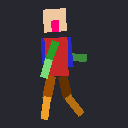 this runthe golden
PASS · 0 px differ
- 01shot on one reference graphics card
- 02compared pixel by pixel
- 03accepted by a person, in a reviewed commit
the same character, three ticks
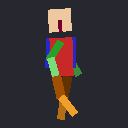 tick-03
- tick-35
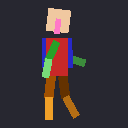 tick-40
verbatim from the engineAccepted goldens from the engine's 2D rig tests, shown at their own pixels and scaled without smoothing. The engine has 189 accepted goldens today.
stage 1-5Held to a reference
Measured against the tools you already trust.
We do not grade our own homework. Each part of the engine is held against the tool the industry already relies on for it, on the same scenes.
Where our answer differs, the difference is written down with both numbers and a reason, and the disagreement is settled toward the reference.
| Press Start | the reference |
|---|---|
| Physics | Jolt · PhysX |
| Navigation | Recast |
| UI layout | Chromium · Yoga |
| Text shaping | HarfBuzz |
| Lighting | Mitsuba |
| Meshes | Blender · Manifold |
Parity is the bar. Not every feature meets it yet, and the misses are recorded.
Held to a referenceReference tools are named as plain text. They are compared against and never ship in the engine.
stage 1-6The game answers back
The game answers back.
An agent cannot squint at a screenshot and know the game is right. So a running Press Start game answers four verbs: query, command, capture and control.
Your agent asks for the state, changes it through one door, takes a picture and steps time, on the same surface the engine's own tests use. You bring the AI. The engine brings data and verbs.
- query4 bodies · ball at 286, 35 · score 1 : 0
- commandball placed at the centre · journal #1
- capturecaptured · id 7bf92eca
- controlstepped to tick 132 · checksum 7bf92eca
illustration · drawn in your browserAn illustration: the engine's four verbs played on the small browser simulation. The verbs are the engine's; the game is a sketch.
stage 1-7Your code
Your game is your code.
A game on Press Start is a normal Rust codebase, and it is yours. 89 engine crates bring what a game needs: terrain, physics, animation, UI, navigation, networking and more.
Nothing hides behind a menu. The engine is tested the way your game will be: by code that runs, steps and asserts.
A game is Rust code plus documents, both plain text.
Read moreuse press_start_test_app::{advance, fixed_step_app};
#[derive(Resource, Default)]
struct TickCount(u64);
fn count_ticks(mut count: ResMut<TickCount>) {
count.0 += 1;
}
#[test]
fn three_fixed_steps_a_frame_are_thirty_after_ten_frames() {
let mut app = fixed_step_app(3);
app.init_resource::<TickCount>();
app.add_systems(FixedUpdate, count_ticks);
app.update(); // priming: Startup runs, zero fixed steps
assert_eq!(app.world().resource::<TickCount>().0, 0);
advance(&mut app, 10);
assert_eq!(app.world().resource::<TickCount>().0, 30);
}
stage 1-8Built today
What is built, counted by a tool.
We keep a checklist of everything a full game engine needs: 404 features, from terrain to crash reports. A feature counts as built only when a test holds every line of its description, and the tally is made by a tool, never by hand.
Today 103 are built and 129 are partly there, with the missing parts named. We publish the misses.
103of 404 · built
- World buildingscenes, terrain, 2D, navigation16/54
- Simulationphysics, input, cameras17/67
- Renderinglighting, shaders, textures7/57
- Asset creationmodeling, rigging, animation18/75
- Game servicesaudio, UI, save, localisation24/85
- Reachnetworking, export, platforms4/42
- Beyond the usualwhat no engine ships, written down anyway17/24
stage 1-9The road
Where we are.
Press Start is not public yet. This is where it is going, one line a stop, with no dates.
- Nowyou are herePrivate beta. The engine is built and tested in private, and the list is open.
- NextVersion 1. A launcher, a new project from a template, save, build, Windows export. No account required, and it works offline.
- ThenVersion 1.x. Regular releases, more of the engine, more platforms.
Want in early?
Join the beta and we email you when version 1 opens. Nothing else, unless you ask.